As Climate Change becomes a bigger issue, researchers grapple for reliable data showcasing repeating climate patterns. Among the tools researchers have begun to employ is the use of shellfish. Sclerochronology is a cost-effective way to understand past environmental data, and is becoming increasingly popular in the scientific industry. Understand the tools researchers use to form new data with this post!
The Arctica Islandica, a shellfish inhabiting the North Atlantic Ocean, lives over 500 years. This mollusk harbors countless growth rings, and like other shellfish, contains detailed information on past climates. Known as sclerochronology, the study of shellfish is a highly efficient tool for paleoclimatologists, especially when cross-dating organisms to produce high-level datasets.
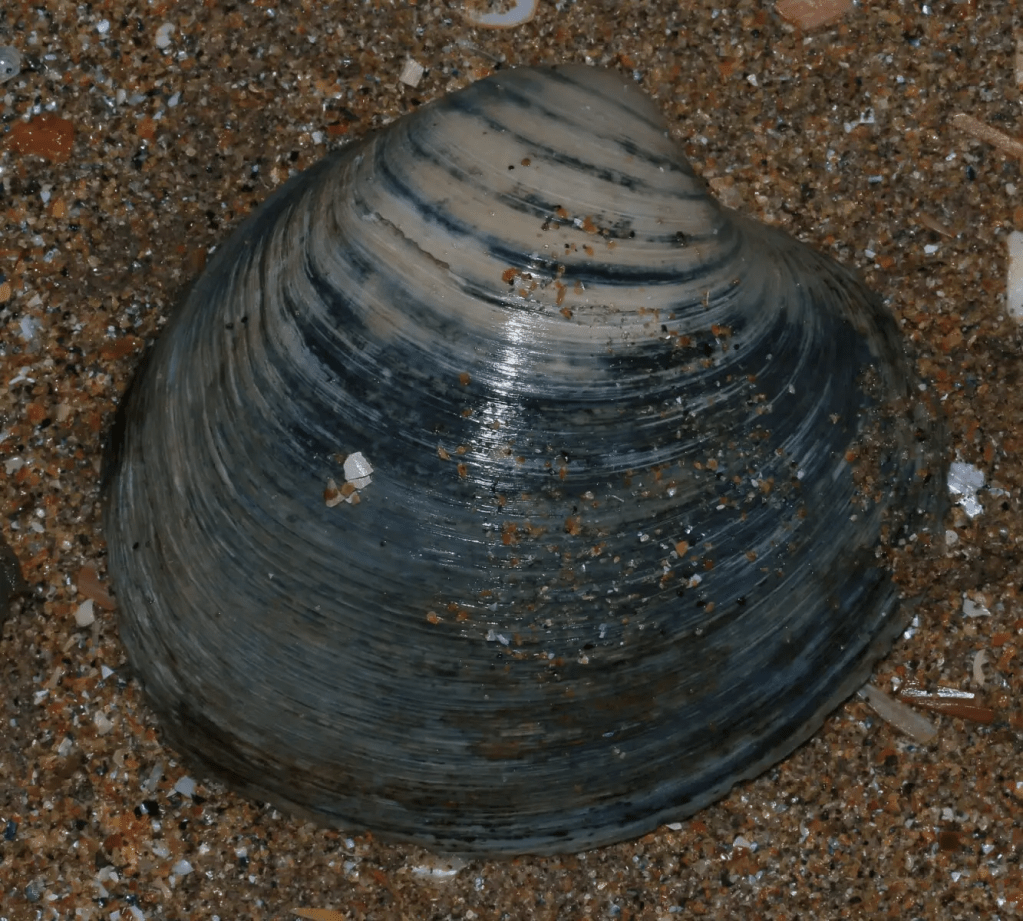
Young Arctica Islandica. Credit: animalia.bio
Sclerochronology is the study of periodic growth patterns recorded in the hard tissues of animals which grow by accretion. In particular, sclerochronology is famous for its usage of shellfish to understand past environmental data. Mollusks are especially useful because of their hinged structures, mainly composed of calcium carbonate, which allow for carbon dating, a method used to determine an organism’s age. Due to periodic deposition, shells in particular provide a simple visual timeline. The growth rings stretching from the umbo to the ventral margin contain valuable environmental information from the past. Similar to dendrochronology, the science of constructing paleoclimates with tree rings, the growth patterns are a natural archive. The detailed patterns help sclerochronologists in understanding climatic changes over time. Of the organisms sclerochronology envelopes, mollusks have been shown to be a uniform, quick way to produce detailed timetables on a large scale, in part due to their many proxies. Proxies, measurable values which correspond to other variables, allow researchers to find a variable from known data. The tools scientists use to understand past climates are generally either proxies, or contain proxies which correspond to the area of research scientists are studying.
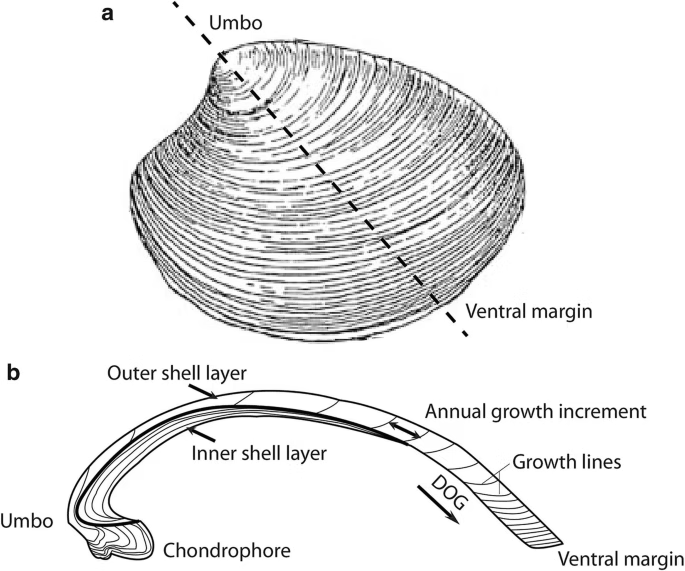
The anatomy of a mollusk. Credit: en.toptrilos.com
One way sclerochronologists gain information from shellfish is through visual cues. Different species of mollusks contain varying levels of accuracy from observing their growth rings. For instance, some shells may grow quickly in comparison to others, forming growth rings every month as opposed to annually, creating shorter yet more detailed timelines. After determining the age of a single shell, sclerochronologists can work backwards, finding corresponding shells which overlap with the older areas of the shell near the umbo. Though finding matching shells in this way is a painstaking task, in particular with shorter-lived mollusks, in this way, researchers can create detailed extended timelines otherwise not available from a single shellfish.
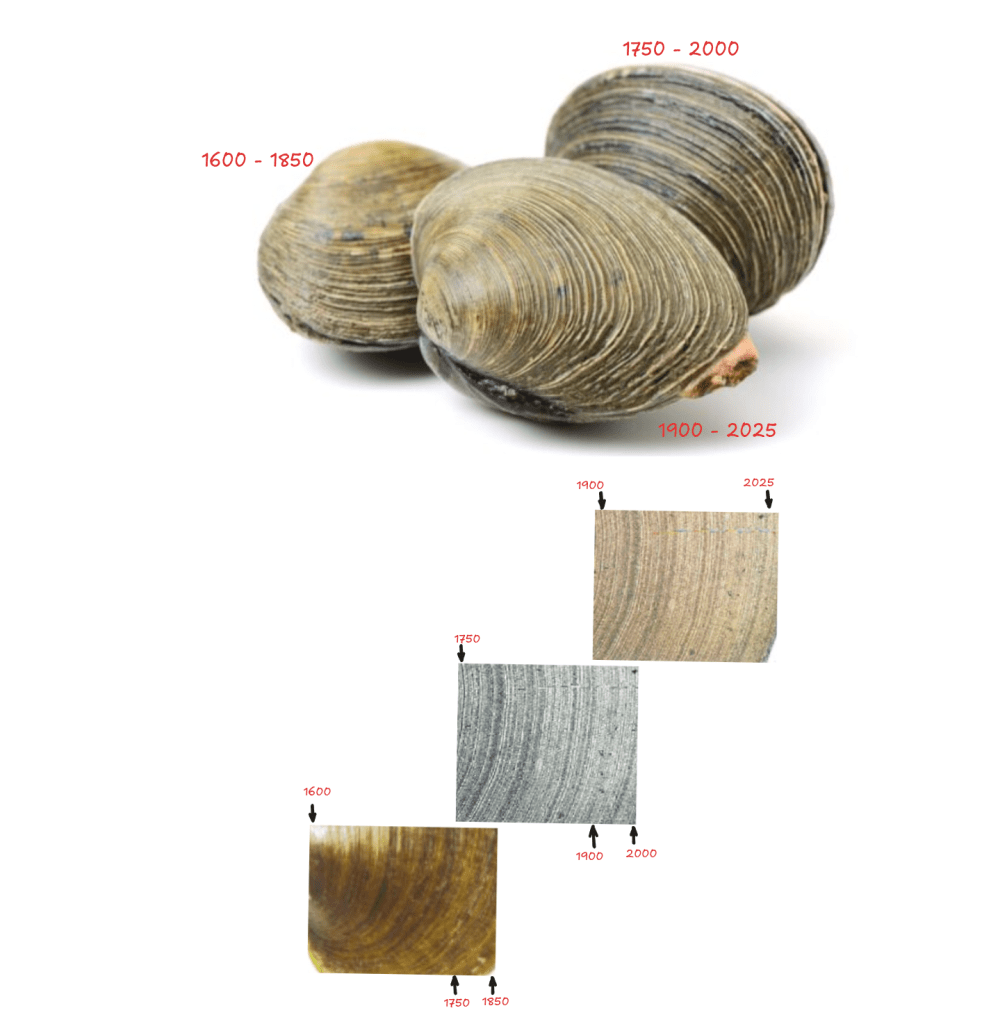
Cross-dating with sclerochronology
Additionally, growth ring thickness can be analyzed to determine broad estimates on environmental factors such as nutrient availability and average ocean temperatures. But the scope of sclerochronology extends beyond simple visual understanding. By checking the chemical composition of different shells, sclerochronologists can understand important past environmental information, such as ocean temperatures, salinity levels, and even wind patterns. A widely used proxy for these values are oxygen isotope levels.
Oxygen isotopes refer to oxygen molecules which contain different quantities of neutrons. O16 is a naturally occurring isotope, accounting for most of the oxygen on Earth. O18, on the other hand, contains an additional two neutrons, creating a heavier molecule.
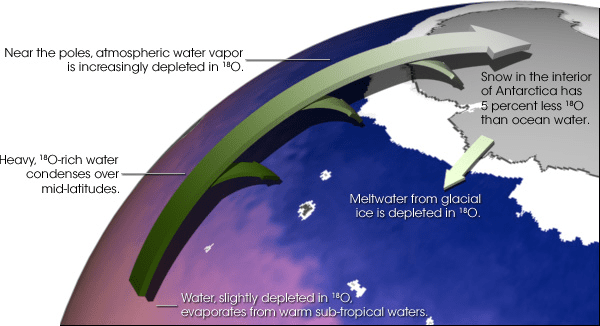
How O18 and O16 are distributed throughout the oceans. Credit: earthobservatory.nasa.gov
The ratios of oxygen isotopes in the accreted tissues of shellfish allow researchers to gain clues related to when the organism lived, the water temperatures in its habitat, ocean salinity levels, and more. By understanding the O16 to O18 ratios in different areas of the world at different seasonal points in time, researchers have the ability to understand information based on the ratios.
In order to be able to analyze the chemical composition of shells, researchers turn to high-precision instruments. Using an extremely fine-tipped drill mounted on a stand, researchers are able to bore a hole in a particular area, such as part of a growth ring on a mollusk. This creates an incredibly fine powder of the shell from a select growth ring, or time frame. In this way, sclerochronologists are able to collect tiny samples of the powdered shell from different times. This powdered shell is then analyzed for its molecular makeup. Due to the natural course of Earth’s weather cycles, scientists are then able to infer information from the time period the select shellfish lived in.
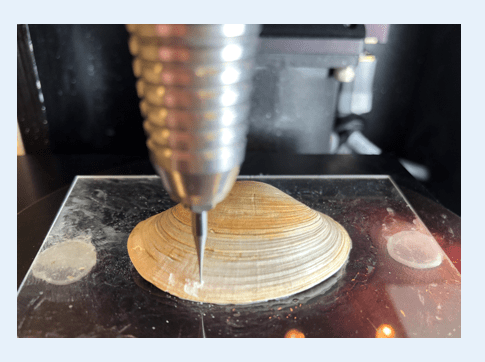
Drilling shellfish growth rings. Credit: Grossman and Ku, 1986
Sclerochronology allows scientists to gain information about past climates that otherwise would not be accessible easily. With some species living up to 500 years, shellfish hold keys to paleoclimate information on a startling scale. Not only can shellfish be found on ocean beds, but have also been used as a reliable food source by humans for centuries, making shellfish an exploitable key on anthropology. By utilizing sclerochronology, scientists can create millennia-long timelines with a high degree of accuracy, providing information on past climates, human diets, and more. Shellfish are an efficient way to reconstruct past environments. As our Earth continues to change, it becomes even more crucial to understand past climate patterns, and sclerochronology allows scientists to do just that.

Citations & Useful Links:
Sclerochronology:
Sclerochronology – Environmental Archaeology
Sclerochronology: Playing back the recordings of life
Using Sclerochronology:
Shellfish Growing Areas | Washington State Department of Health
Growth Rings and Longevity in Bivalves – coa
Grossman and Ku, 1986
Isotopes: Weather and usage
Paleoclimatology: The Oxygen Balance
Why Care About Past Climate? Find Answers in Isotope Analysis – AnalyteGuru
Arctica Islandica: The longest living shellfish
Instructor Information Sources:
Dr. Christine Bassett
Dr. Vera Beilinson
Image Credits:
The Arctica Islandica (Animalia)
Paleoclimatology: The Oxygen Balance
Dr. Christine Bassett; Grossman and Ku, 1986
Molluscs: Anatomy, Growth Patterns, and Diversity
Discover more from Climate Change
Subscribe to get the latest posts sent to your email.

 Climate Change
well written in clear and comprehensible way. Crucial in our understanding of current climate challenges and how to best address them. Thanks !
LikeLike