This blog post focuses on plastic in oceans, in particularly in the Great Pacific Garbage Patch. Unfortunately, the plastic problem runs much deeper, and this blog post only highlights a small portion of this issue. Check out the links to other sites like ours! Click here to view the whole post!
Posted by C4CC (Changeforclimatechange)
Seen from space, it looks like an island. Roughly 1 mile of pure trash, it floats between Hawaii and California. This is the Great Pacific Garbage Patch, a floating island of waste over twice the size of Texas, consisting almost entirely of plastic. Just one of five equally dangerous dumps of plastic in the ocean, the Great Pacific Garbage Patch is the biggest – and the deadliest. Over 99% of the debris is made up of plastics. And among these plastics are microplastics – tiny pieces of plastic almost invisible to the naked eye. As marine life mistakenly consumes microplastics, the particles are lodged in their bodies. When they or their predators are caught and processed by humans, the microplastics come with them, making their way to our plates. In this way, humans have begun to consume microplastics unknowingly.
Microplastics are almost everywhere, from the air we breathe to the food we eat, to the water we drink. How do these tiny pieces of plastic get into our sealed water bottles? Our fresh seafood? The very air we rely on to survive? In an attempt to answer these questions, scientists classified microplastics into three categories, depending on how we consume them and how large the particles were.

Spot the differences.
The first category, “Primary Microplastics” consists of plastics such as glitter, cosmetic beads, and seed coatings (Plastic films used to improve growth). These plastics are smaller than 5 millimeters, and have been intentionally made in small sizes. Other examples include cosmetics, or biomedical products. Primary microplastics, while they may not arrive on our plates, contribute to the presence of secondary microplastics within our bodies, food, and water.
Secondary microplastics are tiny fragments of primary or larger plastics, such as food containers, toys, or synthetic textiles. These tiny fragments are present in our food, and as they are continuously breaking off, are highly concentrated in plastic-bottled water, disposable plastic containers containing food, and other plastic-stored edible materials.
The third group of microplastics is arguably the most dangerous. Nanoplastics are smaller than 1 micrometer, and too small to see with the human eye. These are present almost everywhere – in our food and water, and especially the air. In fact, scientists have found microplastics as far as embedded in the Arctic ice sheets, to remote uninhabitable deserts.
Microplastics are present everywhere we look. And as plastics are dumped more and more into the ocean, we consume more and more microplastics each year. In fact, the average person ingests around 17 credit cards worth of plastic each year, a stunning number almost unfathomable.
Less than 10% of plastics are recycled worldwide, which means that a huge fraction of excess plastics end up in places like the great pacific garbage patch, not only posing dangers to wildlife, but also posing dangers to ourselves.
Seafood is not safe to eat without carefully cleaning and sterilizing, as many fish consume microplastics. Microplastics are constantly being inhaled by humans, with up to 272 microplastics entering our bodies every day, from respiration alone.
A study from the journal Physics of Fluids showed that inhaled microplastics can get lodged into airways on the way to lungs, and remain there for a long time.
The microplastics which do not become lodged in our airways make their way to our lungs, which is equally, if not more, dangerous.
Inhaling microplastics has been proven to lead to dangerous health problems, including lung inflammation, interstitial lung diseases, and even lung cancer. Smaller microplastics can enter the bloodstream and travel to other organs, affecting the nervous system, cardiovascular system, and immune system.
The effects on humans are nerve wracking, but the effects on animals are simply heart breaking.
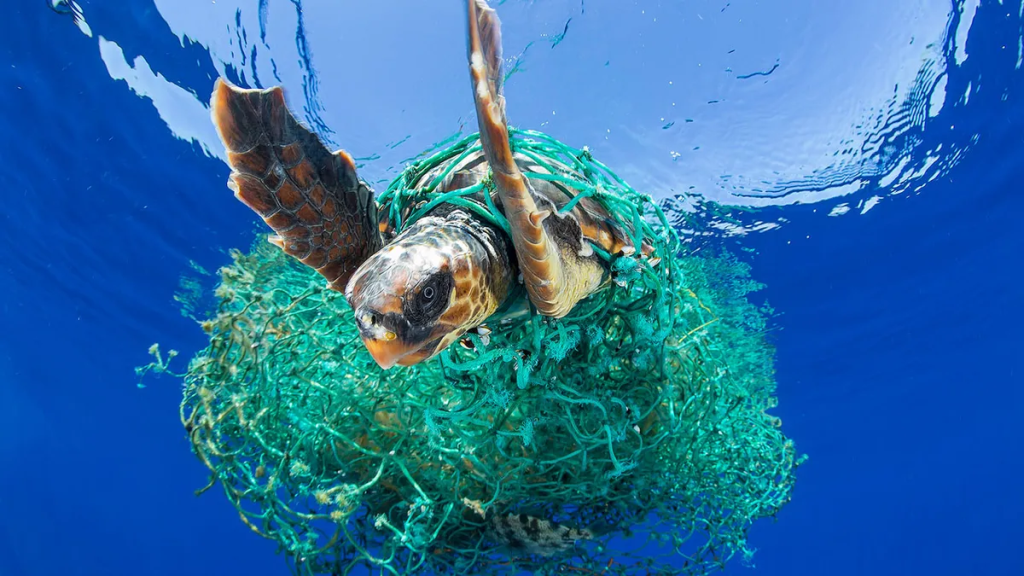
A sea turtle entangled in a ghost net. Credit: The Ocean Cleanup
Over 40,000 recorded marine animals are entangled each year. From just 105 pieces of plastic debris collected, over 480 separate marine organisms were found entangled or dead.
Sea life can mistake the tiny microplastics for food, ingest debris, and die from plastic poisoning or from being caught and eaten (along with the plastic) by humans.
Ghost nets, old fishing gear, and other debris can trap and kill animals who swim near it, which can lead to injuries, starvation, and death.
Even being near plastic is dangerous to sea life. Plastics absorb dangerous chemicals, and underwater the chemicals are released in a cloud. Animals that swim too close risk chemical poisoning and death.
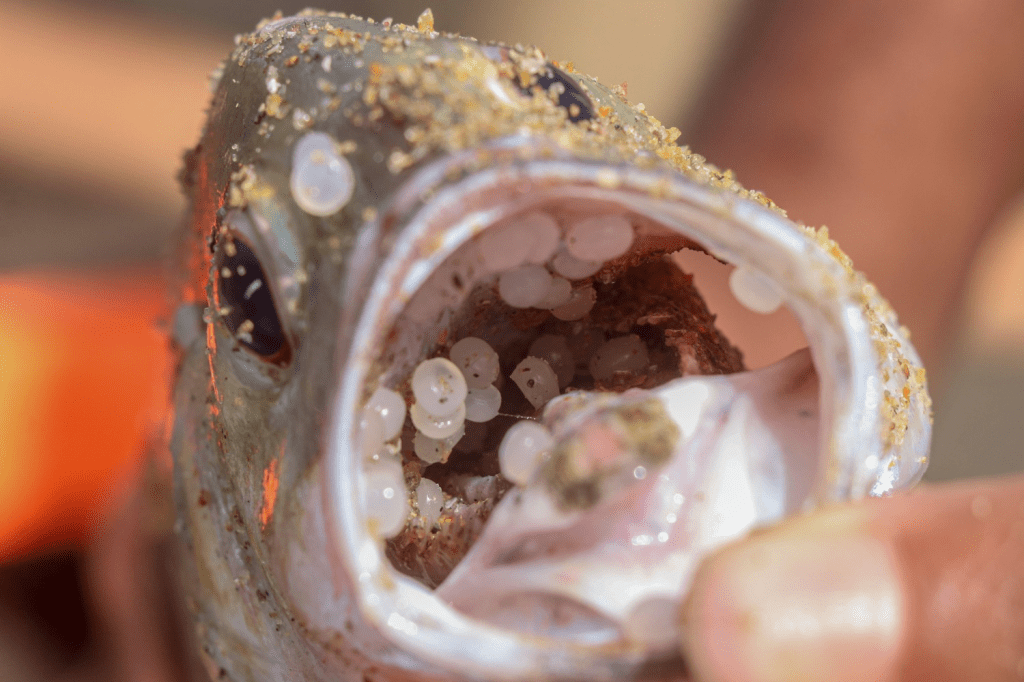
A close up of a freshly caught fish. Credit: Alamy, Environment America
As this threat to our health grows more and more, researchers struggle to find solutions to this growing issue. New, advanced recycling is being put in place in certain countries such as Japan. A new company, NOTPLA, has recently begun creating seaweed-based biodegradable cardboard boxes, which automatically biodegrade in less than two weeks. Other companies have begun to do similar ideas. Microbes charged with breaking down plastics are being released into our garbage dumps on land, and new studies on aquatic species are being conducted. With growing awareness and actions, the plastic pollution issue may be stopped.
Curious? Worried? Here’s some quick things you can start doing in your home to stop the spread of plastics into your body:
- Buying: Stop purchasing plastic-based products or packaging. Items such as models, toys, non-metal water bottles, and others are not only bad for the environment, but also dangerous to yourself. Other products which come in plastic packaging, or use plastic, should be bought sparingly if at all. Examples include plastic bags, plastic wrap, ziploc bags, and styrofoam.
- Food: Avoid using plastic utensils at restaurants. Seafood should be eaten sparingly, and when eaten, should be taken from credible fisheries or restaurants. Avoid taking to-go plastic containers.
- Water: Plastic bottles should be avoided as much as possible. If feasible, avoid drinking water from any source besides your own. Conduct microplastic tests on your tap water; filter the water before consumption.
- Decoration: Glitter, beads, and cosmetics should be avoided.
- Clothing: Synthetic textiles such as polyester, nylon, acrylic, and spandex should be avoided as much as possible.
- Air: Install plastic filters throughout the house. Add an instrument for monitoring plastic levels in the air. Avoid rooms with lots of plastic.
- Reusables: Use reusable items such as (canvas/cloth) bags, (metal) food containers, (metal) water bottles, (reusable) coffe cups, and others. Recycle effectively and efficiently.
Unfortunately, this blog post cannot cover the innumerable problems with plastic pollution. Every day, countless animals and humans are affected by this growing problem. Sites such as theoceancleanup.com and oceanconservancy.org are great resources which host events to clean up beaches and oceans.
If you haven’t already, I encourage you to look for the nearest waste cleanup website near you, and participate in an event. It’s a great way to meet other people passionate about climate change, while making the world a better place. I’ve provided a list of useful links below.
Thank you for reading!
Remember, Change for Climate Change!
Useful Links
4ocean.com, cleanhub.com, earthday.org/campaign, oceanconservancy.org, cleanups.surfrider.org, forbes.com
Some more sources and links:
Notpla, earthday.org, sciencedirect.com, ehp.niehs.nih.gov, theoceancleanup.com, Secondary site for theoceancleanup.com.
After reading this, please consider joining or donating to the ocean cleanup (https://theoceancleanup.com/donate/). Though changeforclimatechange.org is not affiliated with them in any way, they deserve your support as they battle to keep our oceans clean.
Discover more from Climate Change
Subscribe to get the latest posts sent to your email.

 Climate Change
Very inspiring! Will definitely pay more attention to how much plastic I use + recycling. Links are very helpful as well +++
Those poor ocean animals 😦
Really moving article! 5/5
LikeLiked by 1 person