Maybe you hang out in the local coffeeshop on weekends, or brew a quick cup in the morning. Maybe your friends or family drink coffee every day. If so, it may worry you to realize that coffee is going extinct – and it’s our fault. By 2050, coffee won’t be a daily ritual anymore. Unless we act now. There are plenty of wild coffee species with helpful genes we could genetically engineer into our domestic crops. With initiative, we can save our coffee, one gene at a time.
Posted by C4CC (Changeforclimatechange)
Over 2.25 million cups of coffee are consumed each day worldwide. But with climate change significantly affecting coffee production, an important global economy is on the brink of disaster. Domestic coffee crops are failing crescively due to inconsistent weather conditions and increased outbreaks in coffee crop diseases. Though faring worse overall, wild species of coffee contain valuable genes to combat these difficulties. Taking genes from wild species and implementing them among domestic species would make coffee production much easier given the evolving climate. In this essay, we will cover how genes from wild coffee plants can be harnessed to create more durable domestic coffee crops.
Discrepant weather is not only affecting coffee plant growth, but at the same time creating an ideal climate for diseases to grow in. Domestic coffee crops depend on steady rainfall, ideal temperatures, and indirect sunlight to survive (1). Inconsistent weather patterns create unstable conditions for coffee crops, disrupting the steady flow of resources coffee plants need to survive. As weather patterns grow more capricious, coffee plants have scattered times of sunlight and shade, prolonging the production of the fruits (coffee beans). This means they cannot be harvested for some time, during which diseases could strike at any moment, destroying entire farms’ crops. Rising temperatures and unorthodox rainfall patterns have created perfect conditions for diseases and pests to thrive in (2). Disease outbreaks have grown more common due to these changes (3), providing the diseases with more chances to mutate. The more diseases adapt, the less chances domestic coffee species have to adjust to the worsening climate. As weather and diseases become harder and harder to defeat, coffee crops continue to fail more frequently (4).

C. racemosa: The wild coffee species resistant to climate change. Credit: Wikipedia
Though facing their own unique struggles, over many years, wild coffee species have accumulated a genetic “pool”, a group of many genes from many different coffee species, whose purpose is to help the plants survive the rapidly changing climate, and provide protection against new and growing threats (5). For instance, Sudan Rume, a wild coffee species originating in South Sudan, is known for its exceptional disease resistance (6). Another such species is Hibrido de Timor, more commonly referred to as HdT, or the Timor Hybrid. A naturally occurring hybrid of Arabica and Robusta coffee, HdT is resistant to coffee leaf rust, making it a perfect candidate for breeding programs (7). Using the genetic bases already present in HdT, scientists could even modify the plant, making it resistant to a wider variety of diseases. The separated disease resistance from a variety of wild coffee species could be used to create hardier domestic crops. However, the wild species’ gene pool is not limited to disease resistance. Many genes are used by the plants to guard against inconsistent environmental conditions and harsh weather. A common example is C. racemosa, an endangered species of wild coffee (8). C. racemosa is a perfect example of an endangered species which contains important genes to survive changing weather patterns. Maturing quickly, with a lower wilting intensity and resistance to pests, C. racemosa can also undergo higher temperatures and droughts (9). Additionally, C. racemosa shares many genes with C. arabica, the domestic species responsible for over 60% of coffee production worldwide (10). The genes wild coffee species contain have incredible potential to be used for genetically modified domestic crops.
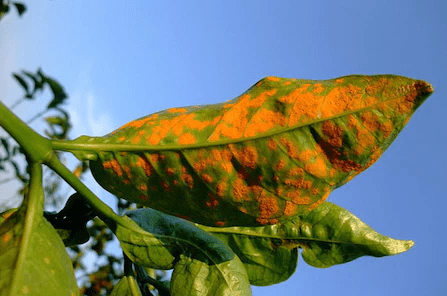
Coffee Leaf Rust, the leading cause of domestic crop failure. Credit: saltspringcoffee.com
Incorporating genes from the “gene pool” created by wild coffee species with domestic coffee crops would be highly beneficial. Because so many wild coffee species have many genes in common with domestic coffee species, integrating the beneficial genes of wild coffee species with domestic crops is made much easier, as only certain genes must be inserted within the arabica or robusta gene template. The main reason many wild coffee species are endangered is due to habitat loss and deforestation. With domestic coffee species, however, this is not a problem, as more than 27 million acres worldwide are dedicated to coffee plantations alone (11), making habitat loss not an issue. If the issue of climate change is met, genetically modified domestic coffee species are more than capable of surviving, and even thriving. With only a few more hurdles to clear, it is imperative to spark the initiative to begin merging wild and domestic species of coffee plants with a large-scale effort.
Domestic species are suffering more due to higher outbreaks in diseases and less consistent weather patterns. However, a solution presents itself among their wild counterparts, many of which contain highly beneficial genes which allow them to survive in harsh environments. Incorporating genes from wild coffee species with domestic coffee crops is crucial to preserve the coffee industry. So many positive genes exist in wild coffee species, genes which are simply awaiting usage. With a bit of ambition, the coffee industry can be changed forever into a thriving economy.
Citations:
2: IPCC | Research Paper, Climate.gov, Science Direct | Research Paper, mareterracoffee.com, bioprotectionportal.com
3: Science Direct | Research Paper
4: Science Direct | Research Paper
6: NIH | Research Paper, coffee-consulate.com
7: Science Direct | Research Paper, Pdf | Research Paper
9: Science Direct | Research Paper
11: Climate.gov
Discover more from Climate Change
Subscribe to get the latest posts sent to your email.

 Climate Change
very informative – good to be aware of climate change effects on our daily life and daily consumption routines.
LikeLiked by 1 person